%20(1).avif)



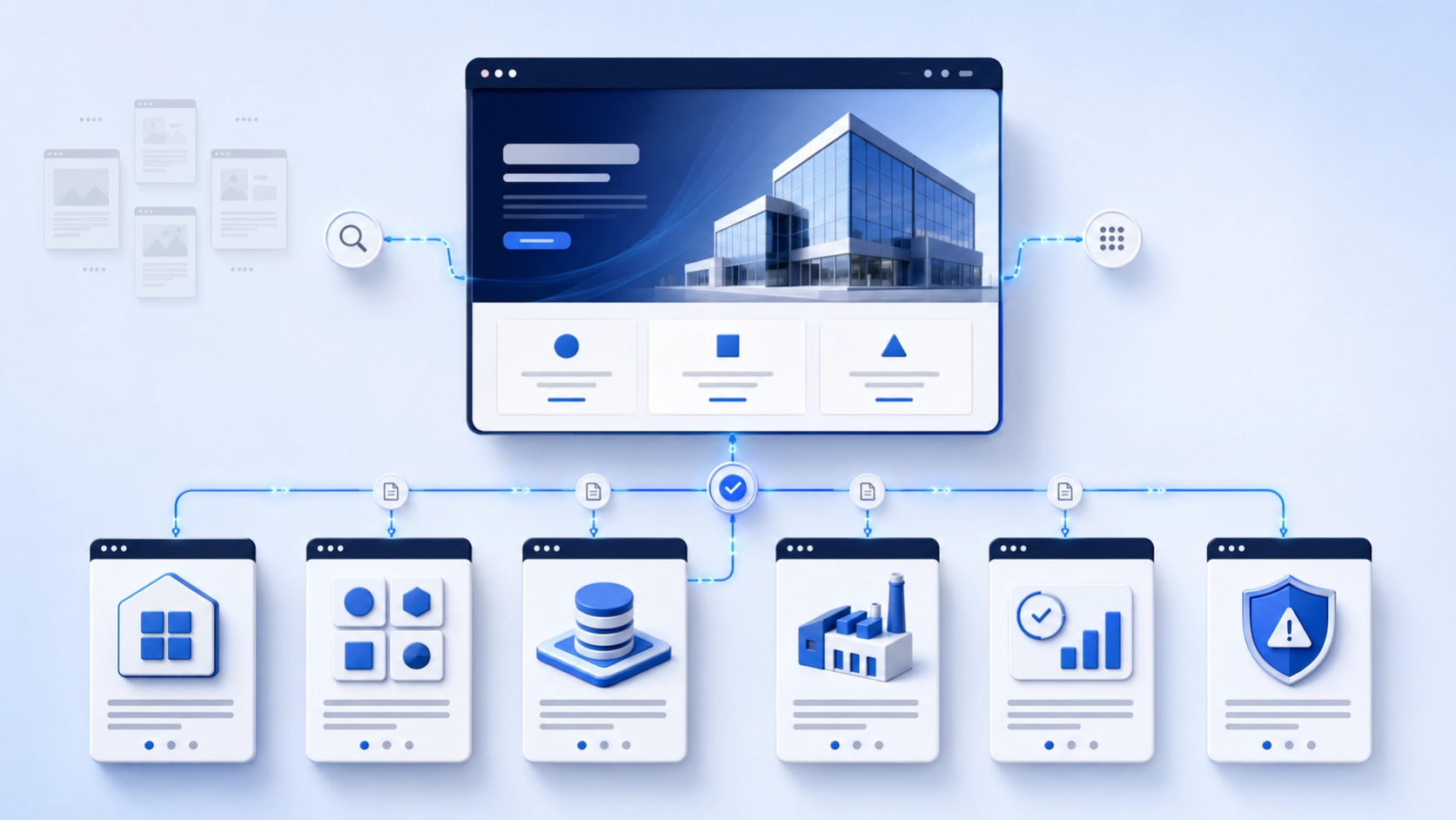
ERP consulting firms should build commercial pages before producing a large blog library. Start with one clear ERP consulting services page, then add platform, capability and industry pages only where the firm has real delivery experience. Support those pages with case studies, implementation-risk content and partner-selection guides that match how buyers shortlist a consultancy.
The wrong order creates a website full of articles with nowhere useful to send a buyer. The right order gives each search intent one page, each claim a source and each visit a sensible next step.
What Pages Should an ERP Consulting Firm Build First?
The first pages should explain who the firm helps, which ERP systems it works with, what work it performs, which industries it understands and how it reduces implementation risk. A practical order is: homepage, ERP consulting pillar, platform pages, capability pages, industry pages, case studies, buyer-risk content and partner-selection guides.
| Priority | Page | Search intent | Proof needed |
|---|---|---|---|
| 1 | Homepage and positioning | Understand the firm | Platforms, industries, delivery model and credible outcomes |
| 2 | ERP consulting services | Find an ERP consultancy | Scope, process, team, exclusions and next step |
| 3 | Platform pages | Find a partner for a named system | Verified relationship, certifications and project evidence |
| 4 | Capability pages | Solve a defined implementation need | Method, responsibilities, dependencies and deliverables |
| 5 | Industry pages | Find relevant sector experience | Processes, risks, terminology and sector-specific proof |
| 6 | Case studies | Check delivery credibility | Starting point, work completed, constraints and measured result |
| 7 | Risk and problem pages | Understand or prevent failure | First-hand guidance, controls and warning signs |
| 8 | Selection and comparison pages | Choose a route or partner | Fair criteria, limits and clear tradeoffs |
What the Keyword Data Actually Says
There is no dependable Semrush US search-volume figure for the exact phrase SEO for ERP consulting firms. Inventing one would be dishonest. The opportunity is supported by adjacent buyer and category demand.
In NexaFlow's August 2026 Semrush snapshot, ERP consultant showed 1,600 monthly US searches with keyword difficulty 11. ERP consulting showed 1,300 searches at difficulty 32, while ERP consulting services showed 880 at difficulty 27. ERP implementation partner showed 260 searches, difficulty 11 and a $22.12 CPC. SEO for software companies showed 390 searches at difficulty 8.
Those numbers do not mean an SEO agency should force an ERP consultancy to rank for every term. They show a live market around consultants, services and partner selection. The page plan must then narrow that demand by platform, industry, capability and risk.
Why ERP Consultancies Need a Different Page Plan
An ERP consultancy is rarely selling one simple deliverable to one buyer. A shortlist may include finance, operations, IT, security, procurement and an executive sponsor. Each person is trying to answer a different question.
- Can this firm work with our chosen ERP platform?
- Has it handled our industry and operating model?
- Who will perform the work after the sale?
- How will data, integrations, testing and cutover be controlled?
- What happens when scope changes?
- Can the team prove a result without hiding the difficult parts?
A generic services page cannot answer all of that. Fifty thin pages cannot answer it either. The site needs a controlled set of pages with distinct jobs.
1. Fix the Homepage Before Building SEO Pages
The homepage should pass a basic qualification test in the first screen. It should say which type of ERP firm this is, who it serves, which systems it works with and what the visitor should do next.
Weak ERP homepages lead with claims such as “transform your business” or “drive digital innovation.” Those phrases could describe almost any consultancy. Replace them with facts.
- ERP ecosystems supported
- Industries and company sizes served
- Implementation, migration, optimization or support focus
- Geographic coverage
- Delivery model
- Named proof or a clear route to case studies
- A next step that fits a long sale, such as a fit call or project review
The homepage should not try to rank for every platform and service. Its main job is to make the firm's position clear and distribute authority to the deeper pages.
2. Build One ERP Consulting Services Pillar
This page owns the broad service intent. It should define the consultancy's actual scope, not recite a textbook definition of ERP.
Include:
- The types of organizations the firm can help
- Platforms and versions genuinely supported
- Project stages the team handles
- Core capabilities
- What the client must provide
- Typical project governance
- Evidence and team credentials
- Clear exclusions
- Links to platform, capability, industry and case-study pages
If the business is an independent selection adviser, an implementation partner and a managed-support provider, explain those roles separately. Do not blend them into a vague “end-to-end” claim.
3. Create Platform Pages Only Where the Proof Exists
Platform pages can target searches around IFS, NetSuite, Sage, Oracle, Microsoft Dynamics and other ERP systems. They are also where buyers test whether the relationship is real.
A strong page states the exact work performed, relevant products or modules, supported regions, certifications, team experience and project examples. Link to the official partner profile when one exists. For context, both IFS and NetSuite operate public partner directories that buyers can use to verify firms.
Do not create an Oracle ERP page because one employee worked on Oracle years ago. Do not describe the company as a certified partner unless that status is current and verifiable. A search page that overstates a vendor relationship is a sales and reputation problem.
4. Give Each Real Capability Its Own Page
Capability pages should match work the consultancy can scope and deliver independently. Common examples include:
- ERP implementation consulting
- ERP selection and readiness
- Data migration
- Systems integration
- Cloud migration
- Business-process design
- Testing and assurance
- Change management and training
- Post-go-live support
- ERP optimization or rescue
Each page needs a distinct problem, process and deliverable. If implementation, migration and integration pages repeat the same copy with three nouns swapped, consolidate them until there is enough substance.
5. Use Industry Pages to Prove Fit, Not Change the Heading
An industry page should show that the firm understands how ERP work changes in that sector. A manufacturing page might discuss planning, inventory, traceability, shop-floor integration and cutover risk. A professional-services page may focus on project accounting, utilization, revenue recognition and multi-entity reporting.
Include the processes involved, common system boundaries, typical stakeholders, known constraints and relevant work. If the only sector-specific sentence is the heading, the page is not ready.
6. Turn Case Studies Into Search and Sales Evidence
Case studies often carry more trust than another opinion article. They should show what happened, not merely announce a successful transformation.
- Client type and operating context
- ERP platform and relevant modules
- Starting problem
- Scope and responsibilities
- Key constraint
- Work completed
- Result and how it was measured
- What cannot be disclosed
- Named reviewer or approval where possible
If the client cannot be named, use a precise anonymized description and explain why. Never invent a metric to make the story look stronger.
7. Publish Content Around Implementation Risk
Buyers do not only search for suppliers. They search around the risks that create the need for a supplier. That includes failed go-lives, data migration, integration gaps, weak adoption, scope creep, rescue work and post-launch support.
These pages work when they contain first-hand controls, decision criteria and warning signs. A generic “ten reasons ERP projects fail” post adds little. A page showing how to assess data readiness before scoping migration can support a real service and a real buyer decision.
8. Add Partner-Selection and Comparison Content Carefully
Selection content can reach buyers before a shortlist is fixed. Useful subjects include how to compare implementation partners, what an ERP proposal should contain, which questions to ask references and how to distinguish a reseller from a delivery partner.
Comparison pages must be fair. State who each route suits, where the firm has a commercial interest and which facts could change. A fake comparison written only to declare the author's service the winner will not survive a serious procurement review.
9. Build Team, Method and Proof Pages
People buy ERP consulting from people. Team profiles should show roles, current certifications, platforms, sectors, project responsibilities and useful published work. The methodology page should explain governance, discovery, testing, migration, cutover and support without exposing client-confidential material.
NexaFlow's founders come from MSP, cloud, Azure and Microsoft backgrounds. That experience informs how we think about technical buyers, evidence and multi-person sales. It does not make us ERP implementers, and this article does not claim that it does. ERP delivery claims should come from the consultancy's own qualified specialists.
A Page-to-Intent Map for an ERP Consultancy
| Buyer question | Best page type | Recommended action |
|---|---|---|
| Can you implement our chosen system? | Platform plus capability page | Request a fit review |
| Have you worked in our sector? | Industry page and relevant case study | View the project evidence |
| Can you migrate our data safely? | Data-migration service page | Discuss data readiness |
| Why is our implementation at risk? | Risk guide linked to a rescue service | Book a project health check |
| How should we compare firms? | Partner-selection guide | Use the evaluation checklist |
| Can we trust the delivery team? | Team and method pages | Meet the proposed specialists |
Do Not Build These Pages Yet
- A page for every ERP platform regardless of experience
- Dozens of location pages for offices that do not exist
- One article for every slight keyword variation
- AI-written definitions that add no delivery knowledge
- Competitor comparisons with no fair evidence
- Case studies with no client context or measurable result
- Separate service pages that cannot explain a distinct scope
Google's current guidance for generative AI search also warns against producing many pages for query variations and says to focus on unique, people-first content. See Google Search Central's official guidance.
How to Prevent Keyword Cannibalization
Give every target intent one primary owner. The ERP consulting pillar owns the broad service. A NetSuite page owns NetSuite consulting. A manufacturing page owns sector fit. A data-migration page owns the migration service. An article should answer a question and link to the appropriate commercial page.
If two pages serve the same audience, answer the same question and ask for the same next step, they probably need to be merged. Changing the title is not enough.
A Practical 90-Day Build Order
- Weeks 1 to 2: confirm positioning, services, platforms, industries, proof and target markets.
- Weeks 3 to 4: repair the homepage and build the ERP consulting pillar.
- Weeks 5 to 7: publish the strongest platform and capability pages.
- Weeks 8 to 9: publish one evidence-backed industry page and two case studies.
- Weeks 10 to 11: create one risk guide and one partner-selection guide.
- Week 12: review internal links, indexation, conversion tracking and sales feedback.
This sequence is not universal. A firm with a strong website but weak case studies should change the order. The point is to remove the commercial gaps before chasing a large publishing target.
Measure Pipeline Signals, Not Blog Volume
- Qualified organic enquiries
- Platform and industry pages viewed before contact
- Fit calls and project reviews
- Case-study engagement
- Assisted opportunities in the CRM
- Search impressions and clicks for relevant non-brand terms
- AI mentions and citations for a fixed set of buyer questions
- Sales objections that content helped answer
Rankings matter, but a number-one result for an irrelevant definition is weaker than a smaller query that leads to a qualified implementation conversation.
Related ERP Marketing Guides
- Build the wider ERP marketing strategy
- Review what an ERP website must prove before a demo
- Connect content with an ERP lead-generation system
- See the SEO, AEO and GEO playbook for ERP companies
Need an ERP SEO Page Map?
NexaFlow can audit the current site, map one search intent to each page and show which commercial pages should be repaired before more content is produced. Book a call to review the ERP consulting website.