%20(1).avif)




SEO for Investment Firms: The First Pages You Need to Build to Rank
Most investment firms make the same SEO mistake at the start.
They publish a few market-commentary posts, add generic copy to their homepage, and wait for rankings to appear.
It rarely works.
Investment-related searches are competitive, high-trust, and closely tied to decisions that can affect a person’s financial future. Google treats this type of subject as Your Money or Your Life content, which means a polished website with vague copy is not enough. Your site needs to make it clear what the firm does, who it serves, who is behind the advice or investment process, and why a prospective client should trust you.
That changes the order in which you should build pages.
Before you invest heavily in a resource hub or publish fifty articles about market trends, build the pages that do two jobs:
- Capture the commercial searches people use when looking for an investment firm or specialist service.
- Give prospects, search engines, and compliance teams enough evidence that your firm is real, credible, and transparent.
This guide breaks down which pages investment firms should build first, which ones should come later, and where firms waste time building pages that are unlikely to rank or convert.
The Short Answer: Build Commercial and Trust Pages Before Content
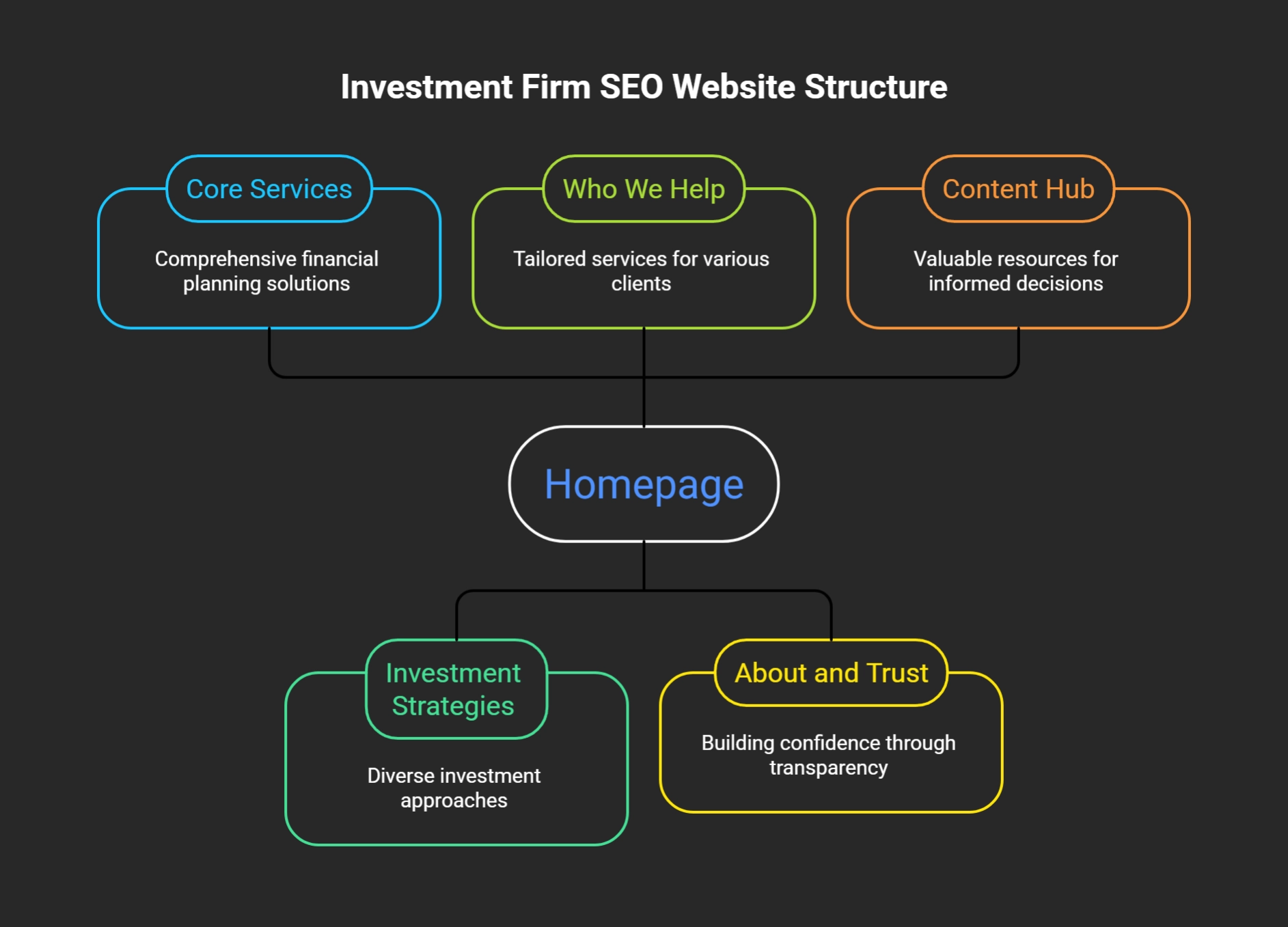
The first pages an investment firm should build are usually:
- Core service pages
- Investment strategy or asset-class pages
- Client-type or investor-profile pages
- Team and investment-professional profiles
- About, regulatory, and trust pages
- Contact and location pages
- Case studies, credentials, or proof pages
- Educational guides and FAQs
That order matters.
A guide about “how to invest during volatile markets” is useful, but it will struggle to generate meaningful leads if the rest of the website does not explain what your firm offers, who manages money, where you operate, or how clients can engage with you.
Content gets attention.
Commercial and trust pages make that attention useful.
Why Investment Firm SEO Is Different
Investment firms are not selling a simple product with a short buying cycle.
A prospective client may spend weeks or months researching firms, comparing approaches, checking team credentials, reviewing investment philosophy, reading market commentary, and assessing whether the company feels credible enough to trust with capital.
That means your SEO strategy has to work across the full decision process.
Someone searching for:
- “wealth management firm for business owners”
- “private equity investment management firm”
- “investment management London”
- “retirement portfolio management”
- “ESG investment manager”
- “financial advisor for tech founders”
is not just looking for information.
They are evaluating risk.
Your website needs to answer the obvious questions before the prospect has to ask them:
- What does this firm actually do?
- Who is the ideal client?
- What investment approach do they take?
- Who makes the decisions?
- Are they regulated or appropriately authorized?
- Do they understand my situation?
- Can I trust the claims they are making?
- What happens if I contact them?
No single blog post can answer all of that. You need a website structure that does.

The Page Build Order for Investment Firms
1. Build Dedicated Service Pages First
Your core service pages should be the first priority because they target people already looking for a specific solution.
Do not group everything you offer onto one vague “Our Services” page.
A visitor searching for wealth management has a different need from someone searching for investment management, retirement planning, institutional advisory, or private-market investing. They should land on a page built around that exact need.
Depending on the firm, your first service pages might include:
- Wealth management
- Investment management
- Portfolio management
- Financial planning
- Retirement planning
- Private client services
- Institutional investment management
- Pension advisory
- Private equity advisory
- Estate and succession planning
- ESG or sustainable investing
- Family office services
- Alternative investments
- Discretionary portfolio management
Each page should have one clear commercial purpose.
It should explain:
- Who the service is for
- What problem or goal it addresses
- How the engagement works
- What makes your approach different
- Who delivers the service
- What risks or limitations need to be understood
- What a prospect should do next
What a Strong Investment Service Page Includes
A good service page does not need to be ten thousand words long.
It needs to answer the right questions clearly and credibly.
A strong structure could look like this:
- Clear headline explaining the service and ideal client
- Short explanation of the client problem or financial goal
- What the service includes
- Your investment approach or planning process
- Who the service is best suited to
- The team involved
- Relevant credentials, disclosures, or regulatory information
- Frequently asked questions
- A clear next step
For example, “Wealth Management” is too broad on its own.
A stronger page might be:
Wealth Management for Business Owners Preparing for a Liquidity Event
That page can then address the real concerns of that audience: tax planning, concentrated stock, estate planning, post-sale investment strategy, family wealth, and coordination with other advisers.
Specificity is not a limitation. It is what makes the page relevant.
2. Build Investment Strategy and Asset-Class Pages Next
Service pages explain what you provide.
Strategy pages explain how you think.
For investment firms, this matters because clients and allocators are often choosing an approach as much as they are choosing a provider.
A firm that manages public equities, private credit, venture capital, real estate, infrastructure, fixed income, or ESG portfolios should have dedicated pages where those strategies are a genuine part of the offer.
Examples include:
- Private equity investment strategy
- Private credit investing
- Global equity portfolios
- Fixed-income portfolio management
- Real estate investment management
- Sustainable and ESG investing
- Infrastructure investment strategy
- Venture capital fund management
- Multi-asset portfolio management
- Alternative investment solutions
These are not filler pages created to chase every asset-class keyword.
Only build them when the firm has a real offer, clear expertise, and useful information to provide.
A good strategy page should cover:
- The investment thesis
- The type of opportunities or assets considered
- The role the strategy plays in a wider portfolio
- The decision-making process
- Key risks and limitations
- Who leads the strategy
- Relevant market commentary or research
- How prospective clients or institutional investors can engage
This is where weak investment firm websites usually fall apart.
They describe their approach using phrases such as “disciplined,” “long-term,” “client-first,” and “research-led,” then give no evidence of what that means in practice.
Those terms are not differentiators anymore.
Explain the process clearly enough that a serious prospect can understand how your firm thinks without needing a sales call.
3. Create Client-Type Pages Around Real Investor Needs
Once your main services and strategies are clear, build pages for the client groups you genuinely serve.
These pages are often more commercially useful than broad industry pages because they connect the service to a recognisable situation.
For example:
- Wealth management for entrepreneurs
- Investment management for high-net-worth families
- Financial planning for medical professionals
- Retirement planning for executives
- Portfolio management for trusts
- Investment advisory for charities and foundations
- Family office support for multigenerational wealth
- Institutional investment management for pension schemes
- Financial planning for professional athletes
- Investment services for expatriates
The page should not simply swap the audience name in and out of the same template.
That is thin content, and it gives prospective clients no reason to trust that you understand their circumstances.
Each audience page should show the specific issues that matter to that group.
For instance, a page for business owners could discuss liquidity events, business-sale proceeds, tax coordination, insurance, succession planning, concentrated wealth, and family wealth planning.
A page for charities could discuss governance, investment-policy statements, spending needs, preservation of capital, reporting, and trustee decision-making.
That level of relevance is what separates a useful page from a generic one.
4. Build Team Profiles Before You Build a Huge Blog
For most investment firms, the team page is not an optional company-history page.
It is a conversion page.
When someone is considering handing over significant capital or asking for financial guidance, they want to know who is responsible.
They will look for:
- Investment professionals
- Portfolio managers
- Financial advisers
- Analysts
- Partners
- Founders
- Compliance leaders
- Client-service teams
Your website should make those people easy to find.
Each profile should include more than a headshot, job title, and a short career summary.
Include information that gives the person context and credibility:
- Current role and responsibilities
- Relevant credentials and registrations where appropriate
- Years of industry experience
- Previous firms or relevant positions
- Areas of specialization
- Investment or planning expertise
- Professional memberships
- Media appearances, published research, or speaking experience
- LinkedIn or other professional profiles where suitable
Do not inflate credentials or turn every profile into a sales pitch.
The purpose is clarity.
A client should be able to see who is making decisions, what that person is qualified to discuss, and why the firm has the depth to handle the work.
5. Build About, Trust, and Regulatory Pages Early
A generic About page that says “we put clients first” will not do much for SEO or conversion.
A strong About page gives visitors the story behind the firm and explains why it exists.
It should cover:
- When and why the firm was founded
- The type of clients it serves
- The firm’s investment or advisory philosophy
- Its operating model
- Where it is based
- The experience behind the business
- How clients work with the firm
- Key credentials, memberships, or authorizations where relevant
- Links to team pages, services, contact details, and disclosures
Trust pages should also be easy to find, not hidden in a footer that nobody reads.
Depending on your jurisdiction and business model, these may include:
- Regulatory disclosures
- Privacy policy
- Cookie policy
- Terms of use
- Risk disclosures
- Complaints procedure
- Conflicts-of-interest policy
- Best-execution information
- Client agreement information
- Business continuity information
- Registration or authorization details
This is not legal advice. Your firm should follow its own legal and compliance process for the pages it is required to publish.
From an SEO and conversion perspective, the point is simple: people need to be able to verify that you are legitimate before they contact you.
6. Build Location Pages Only Where They Make Sense
Location pages can be valuable. They are not automatically a good idea.
For local advisory firms, searches such as these can be high intent:
- Financial advisor in [city]
- Wealth manager in [city]
- Investment management [city]
- Retirement planner near me
- Private wealth management [city]
But a location page only deserves to exist when the firm has real relevance to that place.
That could mean:
- A physical office
- A team working from that location
- A local client base
- A specialist service delivered in that market
- A clear reason prospects in that area would choose the firm
Do not create fifty near-identical pages for cities where you have no office, no local team, and no meaningful distinction.
That is doorway-page territory. It creates a weak user experience, adds little trust, and is unlikely to build lasting rankings.
A useful location page should include:
- The specific office or regional presence
- Address, phone number, and contact details where applicable
- The local team or advisers serving the area
- Services available in that location
- Relevant local context
- Directions or meeting information
- Genuine reviews or proof where permitted
- Links to the core service pages
For national investment managers serving institutional clients, local pages may be less important than strategy, team, and research pages.
For adviser-led wealth-management firms, they may be one of the strongest lead sources on the site.
7. Create Proof Pages That Back Up Your Claims
Investment firms often make broad claims but give very little evidence.
They say they are experienced, disciplined, independent, specialist, global, research-led, or client-first. Then the visitor has to take their word for it.
Proof pages help close that gap.
Depending on compliance requirements, they could include:
- Case studies
- Investment-process explainers
- Client stories
- Firm credentials
- Awards and recognition
- Research reports
- Market commentaries
- White papers
- Media coverage
- Partner relationships
- Investment-team publications
- Charitable or community involvement
- Employer and culture pages
Be careful with performance claims.
Any case study, testimonial, return figure, or outcome needs to be accurate, appropriately contextualized, and reviewed through your usual compliance process. Do not use selective results to create an impression that is not representative.
The best proof pages are not overdesigned trophy cabinets.
They answer a real question:
Why should I believe this firm can do what it says it does?
8. Then Build Educational Content and a Resource Hub
Once the commercial and trust foundation is in place, educational content becomes far more valuable.
It can capture earlier-stage searches, support prospects during long decision cycles, and help establish the firm as a credible source of information.
But the content needs a clear role.
Do not publish generic market commentary just because every investment firm has a “News and Insights” section.
Start with questions that your ideal clients genuinely ask.
For a wealth-management firm, that might include:
- How much do I need to retire?
- What should I do after selling a business?
- How does inheritance tax planning work?
- How should I invest a large cash balance?
- What is the difference between wealth management and financial planning?
- How should executives manage company shares?
- What should I consider before moving abroad?
For an investment-management firm, it may include:
- What is the difference between active and passive investing?
- How do private-credit funds work?
- What should institutional investors consider before allocating to private markets?
- How does a multi-asset investment strategy work?
- What are the risks of alternative investments?
- What does ESG integration mean in investment management?
The key is to create content from real questions, not from a keyword list alone.
Your investment professionals should be involved in the process. They do not need to write every word, but their experience, perspective, and review should shape the content.
The Right Content Hierarchy for an Investment Firm
What Not to Build First
There are pages that sound useful but are usually the wrong first move.
A Huge Resource Hub With No Commercial Foundation
Publishing fifty articles before you have strong service, strategy, team, and trust pages is backwards.
The content may bring in traffic, but the site will not make a strong case for why someone should choose your firm.
Build the conversion foundation first.
Thin City Pages
A page titled “Investment Management in [City]” with generic copy and no real local relevance is unlikely to earn trust or lasting rankings.
One strong office page is better than twenty fake local pages.
Generic “Our Values” Pages
Values matter. But an isolated page full of vague statements about integrity, excellence, and putting clients first will not rank or persuade anyone.
Show those values through real content: your process, your people, your disclosures, your client experience, and your evidence.
Daily Market Commentary for the Sake of Publishing
Market commentary has a place, especially for firms with genuine research depth.
But publishing shallow reactions to every news event creates more maintenance work than value. Old financial content can become inaccurate quickly, and every article needs an appropriate review process.
Prioritize evergreen client questions and research your team can genuinely own.
Service Pages for Services You Do Not Offer
Do not chase search volume by creating pages for every financial service under the sun.
If you do not provide pension transfers, tax advice, private equity, mortgage advice, or ESG investment services, do not build a page pretending that you do.
A smaller set of accurate pages is stronger than a massive website built around vague promises.
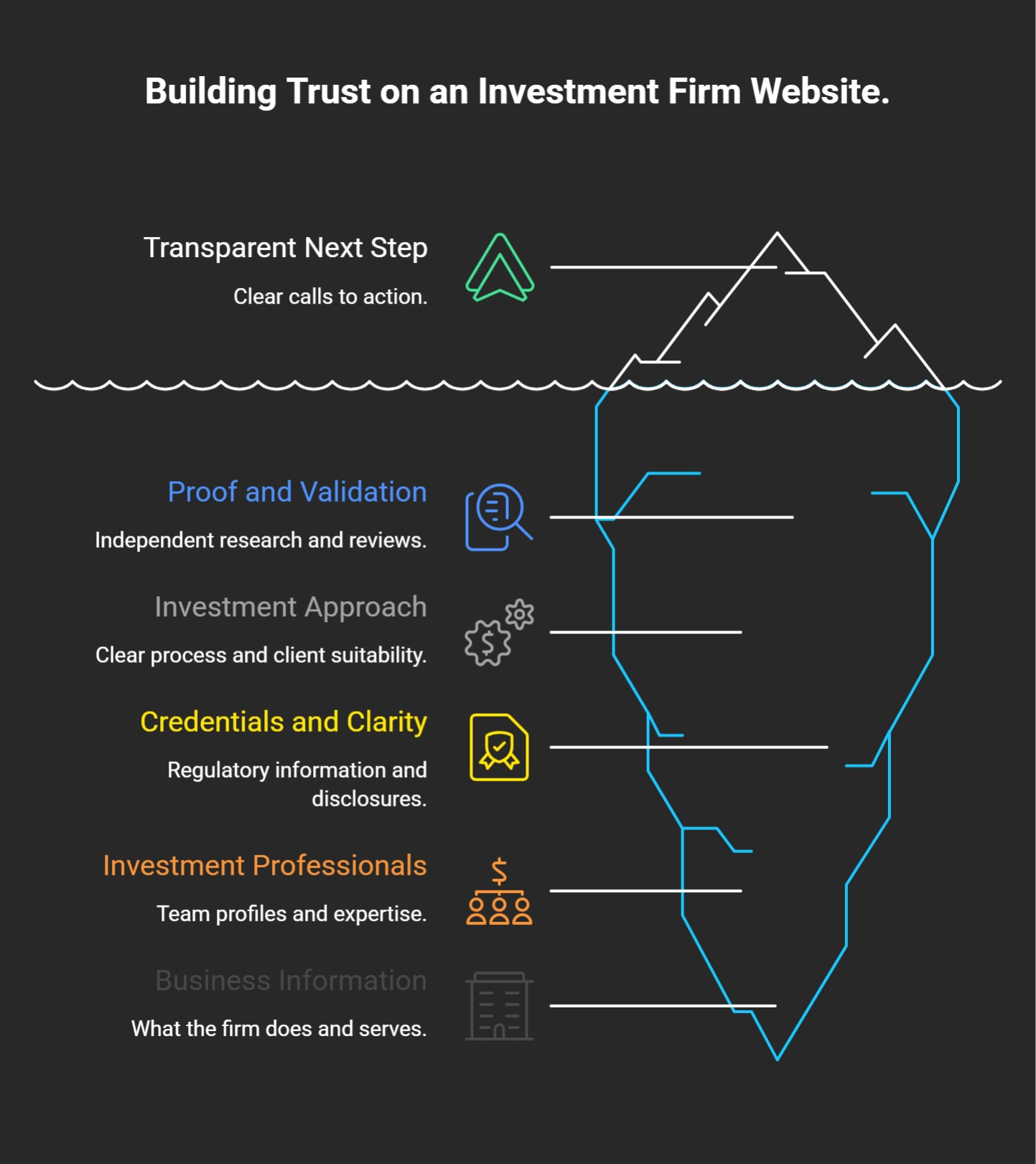
How to Show Trust Across Every Important Page
Trust should not live only on your About page.
Every important page should make the firm easier to verify.
For service, strategy, and educational pages, consider including:
- Clear author or reviewer information
- Links to relevant team profiles
- Publication and review dates
- Accurate disclosures where relevant
- Links to supporting research or primary sources
- Specific examples rather than vague claims
- Clear explanation of risks and limitations
- A real office address or contact route where applicable
- Regulatory information where relevant
- Transparent calls to action
For example, instead of writing:
Our expert team delivers superior investment outcomes.
Write something verifiable:
The strategy is led by a portfolio-management team with experience across public equities, fixed income, and multi-asset portfolios. Meet the investment team and read how the strategy is constructed.
The first statement is generic and potentially problematic.
The second gives the visitor something they can check.
How to Prioritize Pages When You Have a Limited Budget
Not every firm can rebuild an entire site at once.
If you need to make decisions, prioritize based on commercial value and trust gaps.
Start with:
- Homepage messaging and navigation
- Top three to five service pages
- About page and team profiles
- Regulatory, legal, and trust pages
- One or two core investment-strategy pages
- Contact and location pages
- Case studies, research, or credentials pages
- Educational content clusters
A good first phase may be only ten to fifteen well-built pages.
That is better than launching a one-hundred-page site full of thin content, duplicated location copy, and generic AI-written articles.
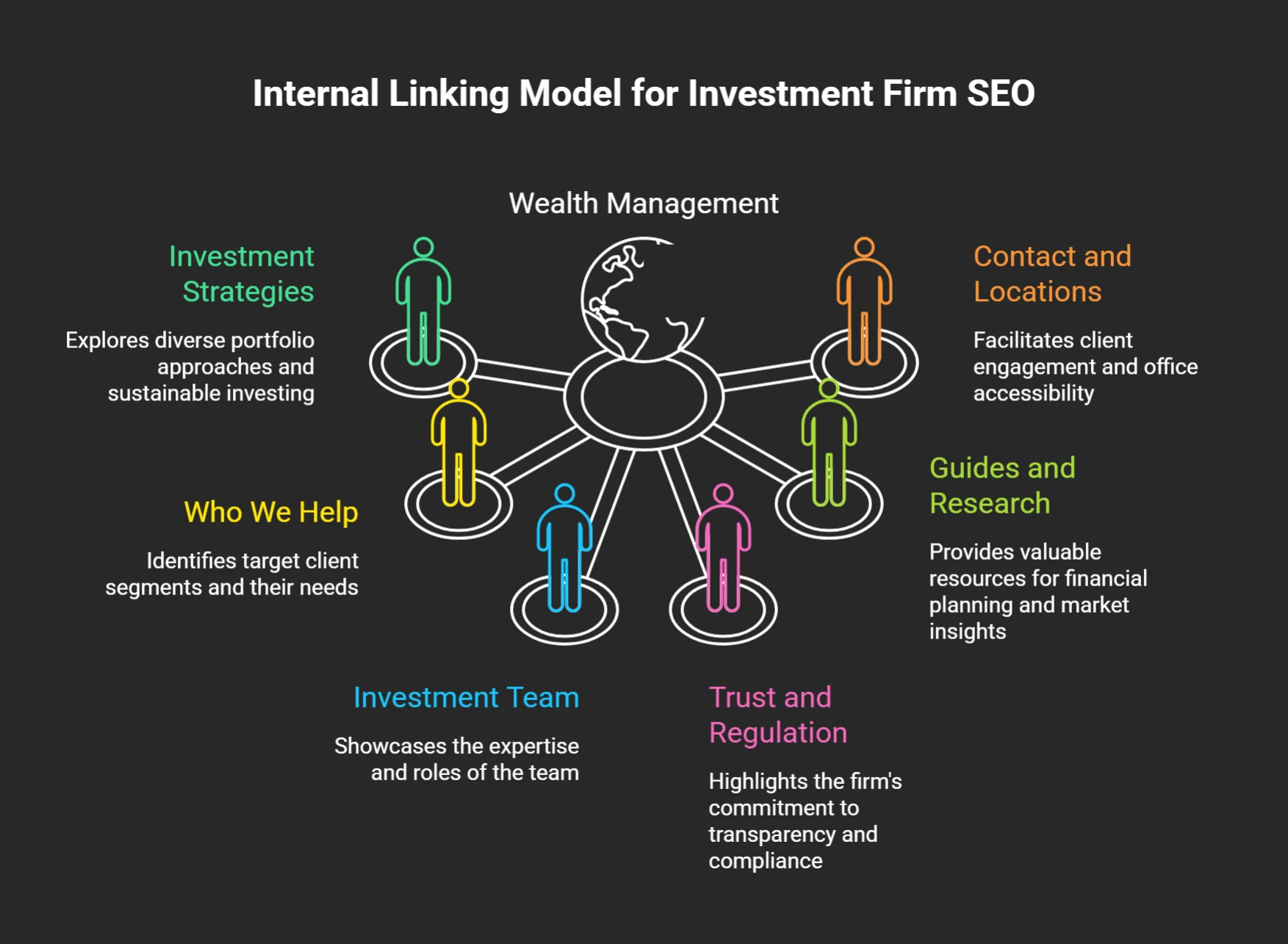
A Simple Internal-Linking Model
Your commercial pages should not sit in isolation.
Create clear links between relevant pages so visitors and search engines can understand the relationship between services, strategies, audiences, people, and educational resources.
For example:
- Wealth Management links to Retirement Planning, Investment Management, Team, and Contact.
- Investment Management links to individual strategy pages, Research, and Investment Team profiles.
- A page for Business Owners links to Wealth Management, Estate Planning, Exit Planning, and relevant guides.
- A guide about preparing for a liquidity event links to the Business Owners page and Wealth Management service.
- Each team profile links back to the strategies, services, or research areas that person leads.
This is not about forcing links everywhere.
It is about creating a site structure that reflects how prospects actually make decisions.
When Should an Investment Firm Start Publishing SEO Content?
Start as soon as the core pages are clear enough to convert visitors.
You do not need to wait until every service and location page is perfect. But you should avoid publishing content into a site that cannot explain its own offer.
A sensible first content plan could include:
- One pillar guide for each core service
- Four to six FAQs around common client questions
- Two to four audience-specific guides
- A page explaining the firm’s investment philosophy
- One or two pieces of original market insight from the investment team
- A clear process for reviewing and updating financial content
For example, a wealth-management firm could start with:
- What Is Wealth Management and Who Is It For?
- Financial Planning for Business Owners: What to Consider Before a Sale
- How Does Discretionary Portfolio Management Work?
- Wealth Management vs Financial Planning: What Is the Difference?
- What Should You Ask Before Choosing a Wealth Manager?
- How Often Should an Investment Portfolio Be Reviewed?
Each guide should support the commercial pages already built, not compete with them.
The Bottom Line
The first pages an investment firm should build are not blog posts.
They are the pages that explain what you offer, who you help, how you invest, who is responsible, and why a prospective client should trust you.
Start with:
- Service pages
- Strategy pages
- Client-type pages
- Team profiles
- About and trust pages
- Genuine location pages
- Proof and research pages
Then build a content hub that answers the questions your ideal clients ask before they are ready to engage.
That is how an investment firm turns SEO into more than traffic.
It becomes a system that helps the right prospects find the firm, understand its value, and feel confident taking the next step.
Need SEO Support for an Investment Firm?
Nexaflow helps investment firms, asset managers, wealth managers, and financial-services businesses build search strategies around trust, clear positioning, conversion-focused site structure, and content that is built for real investor and client questions.
Explore our SEO services for investment and asset-management firms or get in touch to discuss the pages your website is currently missing.