%20(1).avif)



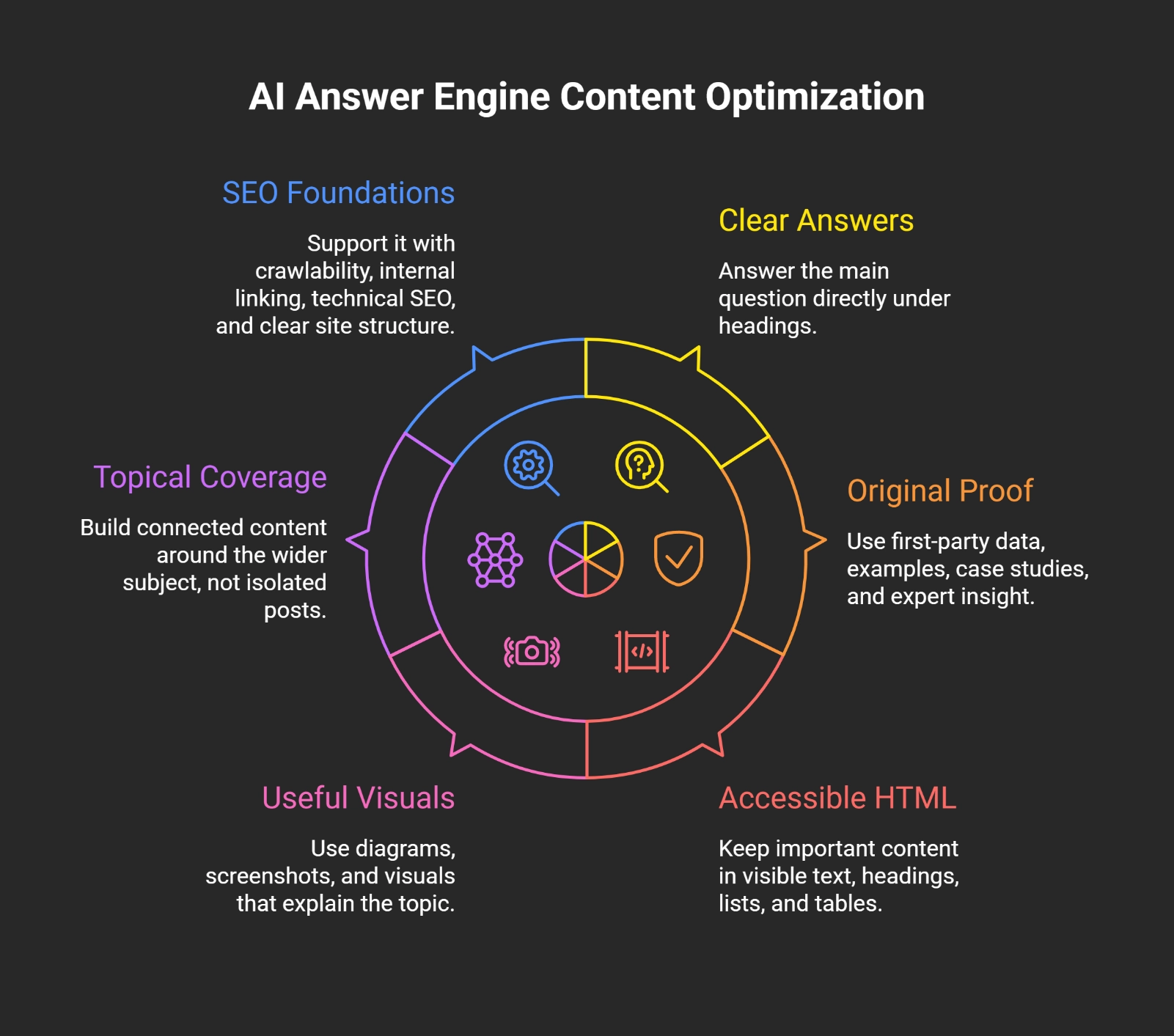
Most advice about optimizing content for AI answer engines makes the work sound like a formatting exercise. Put a short answer below every heading, add an FAQ section, apply schema markup, and wait for ChatGPT or Google AI Overviews to quote the page.
That approach mistakes extractability for authority. An answer engine may understand a perfectly formatted paragraph and still have no reason to use it. If the information is generic, unsupported, outdated, inconsistent with the rest of the website, or disconnected from the question being asked, clean formatting will not make the page a strong source.
Useful answer engine optimization has to solve four different problems. The platform must be able to access the content, understand what it is about, judge the information credible enough to reuse, and find a passage that genuinely helps answer the user's question. Missing any one of those conditions can make the rest of the work ineffective.
What does it mean to optimize content for AI answer engines?
Optimizing content for AI answer engines means making your website easier to discover, interpret, verify, retrieve, and cite when an AI platform responds to a relevant question.
This includes Google AI Overviews and AI Mode, ChatGPT search, Perplexity, Copilot, Gemini, and other search experiences that combine information from multiple sources. These platforms do not all work in exactly the same way, so there is no single trick that guarantees inclusion.
Google states that its normal SEO guidance still applies to AI features and that websites do not need special AI files or unique technical requirements to appear. A page must still be crawlable, indexed, useful, and eligible to appear in Search. You can read that guidance in Google's documentation for AI features and websites.
OpenAI uses a separate crawler called OAI-SearchBot for inclusion in ChatGPT search. A website that blocks this crawler may prevent its pages from appearing as sources in ChatGPT search results, even if Google can still access them. OpenAI explains the distinction between its crawlers in its official bot documentation.
The practical conclusion is that AEO is not a replacement for SEO. It is an extension of good search strategy that places more weight on precise answers, verifiable claims, topic relationships, and the passages an answer engine might retrieve from a page.
The four conditions content must satisfy
A useful way to evaluate a page is to separate the process into four conditions.
| Condition | The question to answer | Common reason a page fails |
|---|---|---|
| Access | Can the platform crawl and retrieve the content? | The page is blocked, incorrectly canonicalized, hidden behind JavaScript, or available only inside an image or PDF. |
| Understanding | Is the subject, audience, product, and question unambiguous? | The copy relies on vague language such as "transforming the future of work." |
| Confidence | Is there a reason to trust and reuse the claim? | The page repeats unsupported claims and provides no sources, experience, methods, or evidence. |
| Usefulness | Does the retrieved passage answer the user's actual question? | The content targets a keyword but avoids the details, tradeoffs, and limitations the reader needs. |
This distinction matters because businesses often try to solve the wrong problem. Adding FAQ schema will not fix a weak argument. Building backlinks to a vague product page will not make the product easier to understand. Publishing another 2,000-word article will not help if the answer already exists but is inaccessible inside a webinar recording.
The work begins by identifying which condition is failing.
Start with the decision behind the search
A keyword describes a topic. It does not always reveal what the person needs to decide.
Someone searching for "AI SEO" could be looking for a definition, a service provider, a measurement platform, an explanation of Google AI Overviews, or a way to make an existing article more visible in ChatGPT. Those needs should not all lead to the same page.
Before writing, establish the question the page will answer and what the reader should understand afterward. A guide about optimizing content should teach the reader how the work is performed. A service page should explain who the service is for, what is included, how the engagement works, and why the provider is credible. A comparison page should help someone evaluate meaningful differences without disguising a sales pitch as neutral research.
This is why AEO cannot be treated as a blog-only strategy. Product pages, service pages, comparison pages, pricing pages, documentation, case studies, and expert profiles may all be useful sources, depending on the question.
Write direct answers without making the article sound robotic
Answer-first writing is useful because readers should not have to dig through an introduction before receiving a meaningful response. The problem begins when every paragraph is reduced to two short sentences designed to look extractable.
A direct answer should open the discussion, not replace it.
Imagine a fictional accounts payable platform with this website copy:
Horizon transforms financial operations through intelligent automation that helps modern teams work smarter.
The sentence is grammatically clean, but it gives a reader or retrieval system almost nothing concrete to work with. It does not identify the customer, the process being automated, the product's role, or its limitations.
A more useful version would be:
Horizon is accounts payable automation software for US SaaS finance teams processing between 500 and 10,000 invoices per month. It extracts invoice data, matches invoices to purchase orders, routes exceptions to the correct approver, and syncs approved bills to NetSuite. It does not replace the company's approval policy or vendor verification process.
The second version contains clear entities, an audience, a workflow, an integration, and a limitation. It is easier to understand because it says something meaningful, not because it uses a rigid AEO template.
The same principle applies to an article section. Give the reader the conclusion early, then explain why it is true, show the evidence, address the exceptions, and describe what the reader should do with the information. That produces a passage an answer engine can retrieve without sacrificing the depth a serious reader expects.
Give the page something worth citing
Generic information has become easier and cheaper to produce. That makes original evidence more important.
If an article repeats the same definitions and tactics already found across dozens of ranking pages, an answer engine has little reason to select that page in particular. The page may still rank, but it is unlikely to become a uniquely useful source.
A strong page usually contains information that came from direct experience, a defined method, original analysis, or a transparent synthesis of reliable sources. For a SaaS company, that could mean showing an actual workflow, explaining how a feature behaves under a specific condition, publishing anonymized product data, or documenting what changed during an implementation. For a professional services firm, it might mean showing a before-and-after example, explaining the reasoning behind a recommendation, or publishing the criteria the team uses to make a decision.
The method behind the evidence matters as much as the headline. If you publish a benchmark, explain the sample, timeframe, exclusions, and calculation. If you share a client result, separate what you directly measured from what the client reported. If you compare products, disclose the criteria and note where the comparison may become outdated.
This is where first-hand experience strengthens both the reader's trust and the page's usefulness as a source. It also prevents the article from becoming another polished summary of information that already exists elsewhere.
Make company and product information consistent
Answer engines encounter a brand across many pages and external sources. If those sources describe the company differently, the system has to resolve the conflict.
A homepage might call the business a growth agency, while the service page describes a design subscription, the LinkedIn profile says branding studio, and third-party listings use an older company description. None of those statements may be entirely false, but together they create ambiguity.
The solution is not to repeat an identical keyword-heavy sentence on every page. It is to define the company's core identity clearly and keep important facts consistent: the company name, main services, industries served, locations, leadership, product names, pricing model, and relationships between the brand and its products.
Named authors, useful team profiles, publication dates, editorial review, and links to primary sources provide additional context. They do not manufacture authority, but they make real experience easier to evaluate.
For topics involving health, law, finance, security, or regulation, expert review and source quality become even more important. An answer engine may summarize a claim, but the business publishing it remains responsible for its accuracy.
Keep the important answer in accessible HTML
A strong answer cannot be retrieved if it is effectively invisible.
Critical information should appear as text in the page's rendered HTML. Do not leave the main explanation inside an image, an untranscribed video, an interactive graphic, or a downloadable PDF. Those assets can add context, but they should not be the only place the answer exists.
SaaS websites require particular attention because important content is often loaded through client-side JavaScript. Google can render JavaScript, but rendering adds another point of failure. Google's JavaScript SEO guidance explains how rendered content, links, status codes, and canonical tags affect discovery and indexing.
Check whether the final HTML contains the product description, comparison information, prices, FAQs, and supporting evidence a visitor can see. Confirm that canonical tags point to the intended URL, internal links use crawlable anchors, and staging or application pages have not accidentally inherited the marketing site's indexation rules.
Crawler controls also need to be deliberate. Google provides controls for participation in its generative AI search features, while OpenAI uses OAI-SearchBot for ChatGPT search. Blocking either system should be a conscious business decision, not an accidental side effect of an old robots.txt file. Google documents its current controls in the Search generative AI control guidance.
Use structure to clarify meaning, not imitate a template
Descriptive headings help readers understand the argument and allow retrieval systems to identify relevant sections. Tables are useful when someone needs to compare options. Lists are useful when order or completeness genuinely matters. Neither should be forced into every section.
A page written as forty miniature answers can become exhausting to read because the ideas never develop. It may look optimized while failing to provide the context that makes its conclusions useful.
A better structure groups related questions into a coherent explanation. If the section is about measuring AI search visibility, it should explain what to measure, why the signals matter, where the data is unreliable, and how the results should influence the next decision. Turning those ideas into four disconnected bullets removes the relationship between them.
Schema markup follows the same principle. Correct structured data can help search engines understand eligible information and support certain search features, but there is no special "AI citation" schema that guarantees an answer engine will use the page. Our guide to schema markup and AI search explains where schema is useful and where the claims surrounding it become exaggerated.
Build connected topic coverage instead of keyword variations
Answer engines can expand one broad question into several related searches. A buyer researching AI search optimization may also need to understand crawler access, schema, measurement, brand authority, content quality, and how AEO differs from SEO.
A website should cover those relationships, but that does not justify producing a separate thin article for every variation of the same keyword. Each page needs a distinct role.
A foundational guide can explain what answer engine optimization is, while supporting articles can examine schema, AI Overview tracking, content optimization, or brand visibility in AI search. The commercial AI SEO page should then explain how those capabilities are delivered for a client.
Internal links help readers move between those questions and help search systems understand the relationship between the pages. The anchor text should describe the destination naturally. "Read our explanation of AI search measurement" communicates more than another generic "learn more" link.
A practical example of improving an existing page
Imagine a B2B SaaS company with a service page titled "AI-Powered Contract Intelligence." The original page contains a bold promise, six feature icons, three anonymous testimonials, and a demo form. It never explains which contracts the system supports, how data enters the platform, what the AI extracts, whether a human reviews the output, or which systems receive the results.
The first improvement is not adding more keywords. It is resolving the missing information.
The revised page could begin by identifying the buyer and job: legal operations teams use the platform to review supplier agreements and extract renewal dates, liability clauses, governing law, and termination terms. A workflow section could show how contracts are uploaded, processed, reviewed, and exported. An integration section could identify the supported document repositories and contract management systems. A limitations section could explain which file types or jurisdictions require additional review.
The company could then support its claims with an annotated product example, a description of its evaluation method, a dated security page, and a case study that states what was measured. Related guides could answer deeper questions about contract extraction accuracy, human review, implementation, and data handling.
That page becomes more useful for search because it becomes more useful for the buyer. The optimization is the reduction of ambiguity and the addition of evidence, not the insertion of an "AI-friendly" paragraph.
Measure visibility, accuracy, and business movement
Traditional SEO metrics still matter. Rankings, impressions, clicks, indexed pages, conversions, and backlinks help explain whether people can find the site and what they do afterward.
AI search adds several questions. Does the brand appear for commercially relevant prompts? Is it cited, merely mentioned, or absent? Is the description accurate? Which page is being used as a source? Does the answer position the business in the correct category? Are referrals or assisted conversions coming from AI search platforms?
Prompt tracking needs context because generated answers can vary by location, account state, wording, and time. A single screenshot is not a reliable trend. Maintain a stable group of prompts mapped to real buyer journeys, test them consistently, record sources and claims, and review changes over time. Combine that information with referral data, lead-source responses, CRM notes, and Search Console reporting where available.
In a recent NexaFlow project for StellarSearch AI, the website problem was not simply a lack of FAQ content. The offer, audience, and proof needed to be clearer across the site. After the rebuild, the client later reported three inquiries where prospects said they had found the company through Claude, ChatGPT, and Google AI Overview. That does not prove one page edit caused the inquiries, but it is a useful business signal that would be lost if measurement stopped at rankings.
Common AEO myths that waste time
One persistent myth is that adding an llms.txt file will make a site appear in every AI answer engine. There is currently no universal standard that gives the file that power. Google does not document it as a requirement for AI Overviews, and OpenAI's crawler guidance focuses on robots.txt access for OAI-SearchBot. Use experimental files only when there is a defined reason, not as a substitute for accessible and authoritative content.
Another myth is that every answer should be reduced to forty or sixty words. Concise definitions can be helpful, but some questions require evidence, conditions, examples, or competing considerations. The correct length is the shortest answer that genuinely resolves the question.
The most damaging myth is that visibility can be guaranteed. AI answers are assembled dynamically, platforms change their systems, and source selection depends on the question and available evidence. A credible agency can improve the conditions that make inclusion more likely, monitor the results, and correct problems. It cannot honestly promise permanent citation for a fixed set of prompts.
How NexaFlow approaches AI search optimization
NexaFlow treats AI visibility as a website and search problem, not a content-formatting package. We examine technical access, page purpose, commercial messaging, supporting content, internal links, structured data, off-site authority, and the accuracy of the brand's presence across search platforms.
That matters because a blog cannot compensate indefinitely for weak product and service pages. When the underlying offer is difficult to understand, the work may require changes to the website architecture and copy as well as new content.
If your website ranks in Google but disappears from AI-generated answers, or if answer engines describe the business incorrectly, our AI SEO services are designed to identify where that chain is breaking. We can then prioritize the pages, technical fixes, evidence, and authority work most likely to improve qualified visibility.