%20(1).avif)




ERP deals rarely fail because the sales deck used the wrong shade of blue.
They fail because the internal champion cannot explain the case to finance, IT sees unanswered integration risk, operations expects disruption, procurement cannot compare scope or the proposal introduces promises that never appeared earlier.
Design matters, but the real sales-enablement problem is information. The buyer needs the right evidence at the right stage in a format they can share internally.
What Is ERP Sales Enablement Collateral?
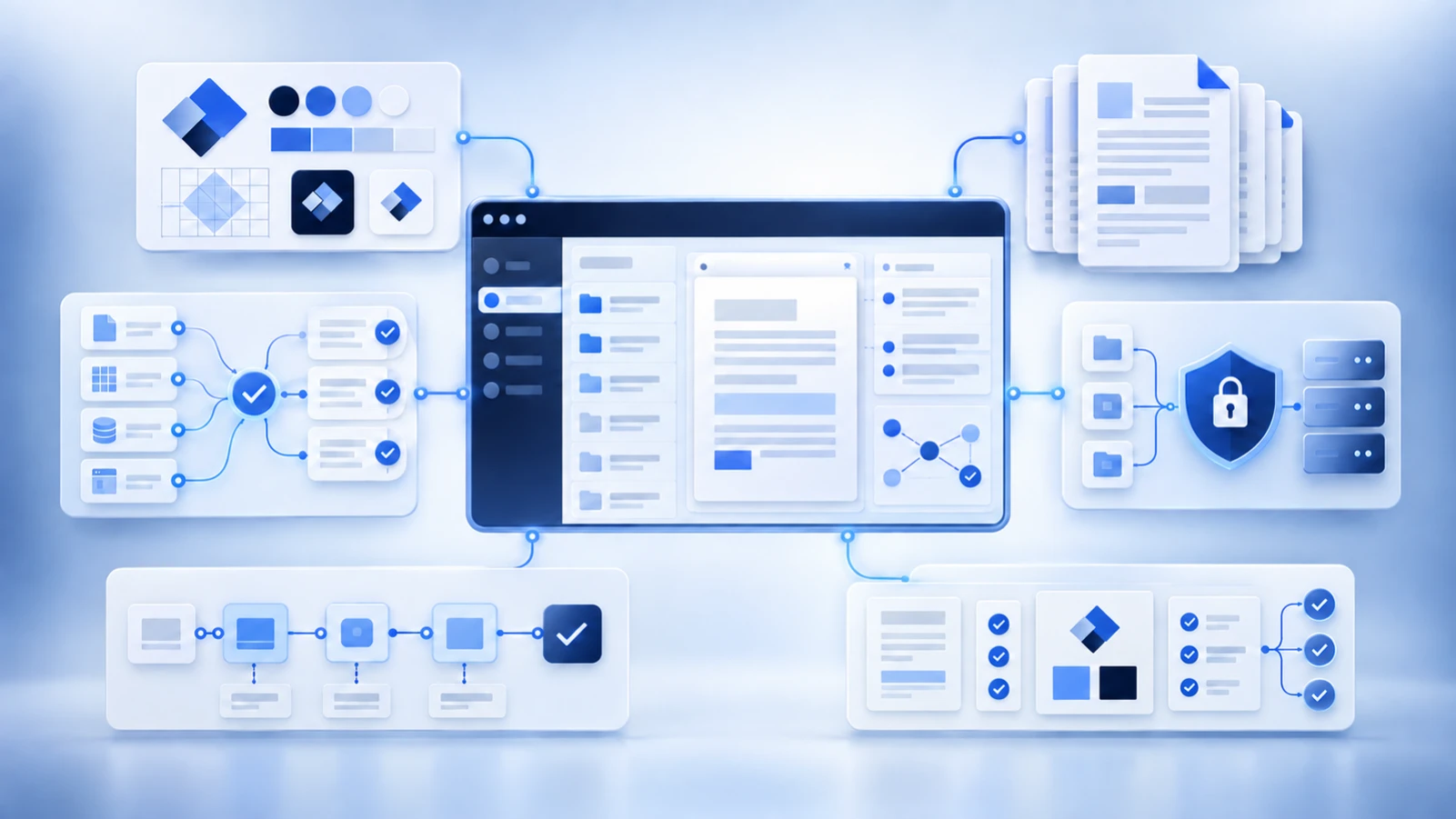
ERP sales enablement collateral is the controlled set of documents, pages and tools that helps sales teams explain the offer, answer stakeholder questions and move a buying group toward a decision. It includes discovery decks, technical one-pagers, business cases, success stories, proposals, implementation summaries and follow-up material.
The word controlled matters. If every salesperson rebuilds these assets from an old presentation, the company does not have a collateral system.
Map Assets to the Buying Stage
| Stage | Buyer question | Useful asset |
|---|---|---|
| Initial research | Is this company relevant to our situation? | Industry page, platform page, concise capability overview and relevant article |
| Discovery | Do they understand the problem and stakeholders? | Discovery deck, question framework and current-state summary |
| Technical review | Will this work with our data, systems and controls? | Architecture, integration, security, environment and support one-pagers |
| Business case | Is the change worth the cost and disruption? | Value framework, cost assumptions, risk comparison and executive summary |
| Proof | Have they handled something comparable? | ERP success story, reference plan and delivery-team profiles |
| Procurement | What exactly are we buying and who owns what? | Scope matrix, responsibilities, assumptions, commercial summary and legal documents |
| Final decision | Can we approve this with confidence? | Proposal, implementation outline, governance plan and next-step schedule |
Build a Discovery Deck That Creates a Conversation
A discovery deck is not a company-history presentation. Its job is to establish the situation, show relevant understanding and structure the conversation.
A useful discovery deck may include:
- The buyer’s current situation and reason for change
- The stakeholders and decisions the project affects
- Known constraints and open questions
- A point of view on the project risks
- Relevant service and platform capability
- A small amount of proof
- The discovery process and next step
Keep detailed architecture, every module and full company history outside the main narrative. Put supporting material in an appendix so the presenter can use it when the conversation requires it.
Create Technical One-Pagers for IT Review
Technical buyers do not need marketing copy stretched across a diagram. They need accurate boundaries.
Depending on the service, one-pagers may cover data migration, integration, security, environments, identity, reporting, performance, testing, release management and support.
Each should state:
- The decision or question it addresses
- The seller’s approach
- Client inputs and responsibilities
- Dependencies and assumptions
- Outputs or acceptance criteria
- Named technical reviewer and revision date
Source check: Microsoft separates solution architecture, environments, data, security, integrations, performance, training and support. Those categories show why one generic technical slide is rarely enough. See Microsoft’s Dynamics 365 implementation guide.
NexaFlow’s MSP, cloud, Azure and Microsoft background helps us ask better questions and present technical information clearly. The ERP seller remains responsible for product and project accuracy.
Give Finance a Business Case, Not a Benefits List
A business case should separate evidence from assumptions.
| Part | What it should show | What to avoid |
|---|---|---|
| Current cost | Known process, system, delay, risk or support costs | A dramatic number with no source |
| Expected change | The specific workflow, decision or capability affected | Broad claims about transformation |
| Investment | Licensing, implementation, internal effort, training and ongoing support assumptions | Showing only the supplier fee |
| Risk | What could delay value and how it is managed | Pretending the plan has no uncertainty |
| Measurement | Owner, baseline, timing and evidence needed | Promising an outcome the supplier cannot control |
When the buyer supplies the numbers, label them as buyer inputs. When the seller uses a benchmark, show the source and date. When the value is qualitative, say so.
Turn an ERP Case Study Into a Usable Success Story
The keyword ERP case study attracts mixed intent, including students and companies comparing software. For a seller, ERP success story is often the better framing because the page is built to prove delivery rather than explain a textbook scenario.
A strong success story includes:
- Company type, scale and operating context.
- Starting system or process and the trigger for change.
- Constraints such as data, locations, integrations or deadlines.
- The exact scope delivered by the seller.
- How the project was approached.
- Verified evidence of what changed.
- What the example does not prove.
If the customer must remain anonymous, provide enough context to make the example useful without revealing confidential information. An anonymous global company with amazing results is not persuasive.
Use an ERP Proposal Structure Buyers Can Compare
A proposal should remove uncertainty, not repeat the sales pitch.
| Proposal section | Purpose |
|---|---|
| Executive summary | Confirm the situation, desired result and recommended path |
| Scope | List deliverables and boundaries in usable language |
| Responsibilities | State what the seller, client and third parties own |
| Approach | Explain phases, governance, reviews and acceptance |
| Assumptions and exclusions | Expose conditions that could change cost or timing |
| Team | Name accountable roles and relevant experience |
| Commercials | Show fees, payment logic and optional work |
| Risks and changes | Explain dependencies, escalation and change control |
| Next steps | Make approval and kickoff actions clear |
Do not bury responsibilities in legal text after the buyer has approved the commercial story. Ownership should be clear during the sale.
Create an Asset for Each Committee Member
| Stakeholder | Primary concern | Shareable asset |
|---|---|---|
| CFO or finance | Value, cost control and reporting | Business-case summary and commercial model |
| CIO or IT | Architecture, data, security and support | Technical review pack |
| Operations | Process fit, disruption and adoption | Workflow map and rollout plan |
| Procurement | Scope, accountability and comparison | Responsibility matrix and proposal |
| Executive sponsor | Strategic case and delivery confidence | Short decision memo |
| Internal champion | Keeping the group aligned | A reusable summary with links to all evidence |
The internal champion is often the forgotten audience. Give them a concise pack they can forward without your narration.
Control Versions and Claims
Sales collateral becomes risky when old files remain in circulation.
- Store approved masters in one location
- Assign an owner and review date
- Lock legal, pricing and technical statements where possible
- Use editable sections only where personalization is genuinely needed
- Retire old versions instead of leaving them in personal folders
- Track which assets sales actually uses
A polished document with an outdated integration claim is worse than an ugly accurate one. Governance is part of design quality.
Measure Whether the Collateral Helps Sales
Do not judge sales enablement by download count alone. Review asset use in live opportunities, time spent rebuilding material, stakeholder questions, proposal revision cycles, stage progression and reasons for loss.
Interview sales and delivery together. Sales knows where buyers hesitate. Delivery knows which promises create problems later. The strongest collateral resolves both.
Create a Reusable Objection Library
Review call notes, lost opportunities and delivery handoffs. Group recurring objections by stakeholder and stage.
| Objection | Weak response | Better enablement asset |
|---|---|---|
| The project looks too risky | We have an experienced team | Risk register example, governance model and relevant success story |
| Integration scope is unclear | We integrate with everything | Integration discovery one-pager with boundaries and dependencies |
| The cost is difficult to defend | The platform will transform the business | Business-case framework with buyer-owned assumptions |
| Our team cannot absorb the change | Training is included | Adoption, role and rollout plan |
| The proposals are hard to compare | Our service is different | Scope and responsibility matrix |
Update the library when a new question appears. Do not force sales to improvise answers that create delivery commitments.
Design Assets as Modules, Not Isolated Files
A modular content system reduces production time and inconsistency. Approved sections can be reused across decks, proposals and one-pagers without becoming uncontrolled copy-and-paste.
- Company and category explanation
- Platform relationship and capability
- Delivery method
- Team biographies
- Technical responsibility statements
- Approved proof blocks
- Commercial and legal language
Each module should have an owner, approval date and known places where it appears. Personalization should happen around the buyer situation, not by rewriting verified claims.
Make Collateral Accessible and Easy to Use
Committee members may read documents on a laptop, phone, printed page or screen share. Use readable type, strong contrast, descriptive headings, meaningful link text and tables that survive export.
Provide the correct format for the job. Sales may need editable PowerPoint. A buyer may need a tagged PDF. A webinar may need a lighter visual version than a detailed leave-behind document.
Test exported files. Fonts, links, charts and page breaks can fail even when the source deck looks correct.
Use a 60-Day Sales-Asset Repair Plan
- Week 1: inventory every asset and identify unofficial versions.
- Week 2: interview sales and delivery; map stages, stakeholders and objections.
- Weeks 3–4: rebuild the discovery deck, technical one-pager and success-story template.
- Weeks 5–6: rebuild the proposal and responsibility matrix.
- Weeks 7–8: train the team, retire old files and measure real use.
The objective is not to redesign everything. Repair the few assets that appear most often in qualified opportunities, then extend the system.
Related ERP Sales and Marketing Guides
- Build the wider ERP marketing system
- Make the website carry the same proof
- Fix positioning before rebuilding sales material
- Choose a delivery model for recurring collateral
Need an ERP Sales-Asset System, Not Another Pretty Deck?
NexaFlow designs discovery decks, proposals, one-pagers, success stories and presentation systems around the way a buying committee makes decisions. We can work from approved content or help structure the information before design begins.