%20(1).avif)



Why SaaS messaging matters more than your design
A SaaS product is invisible. Nobody can hold it, test it in their hand, or “get it” at a glance like a physical item.
So your website has one job in the first few seconds: make the value obvious.
Most SaaS websites miss because they talk like this:
- “AI-powered platform for modern teams”
- “Unlock productivity with smarter workflows”
- “All-in-one solution at scale”
Cool. That tells me nothing. A visitor doesn’t want poetry, they want clarity.
That is the answer Google wants. Now let’s unpack how to actually do it.
The real problem: you’re describing the product, not the outcome
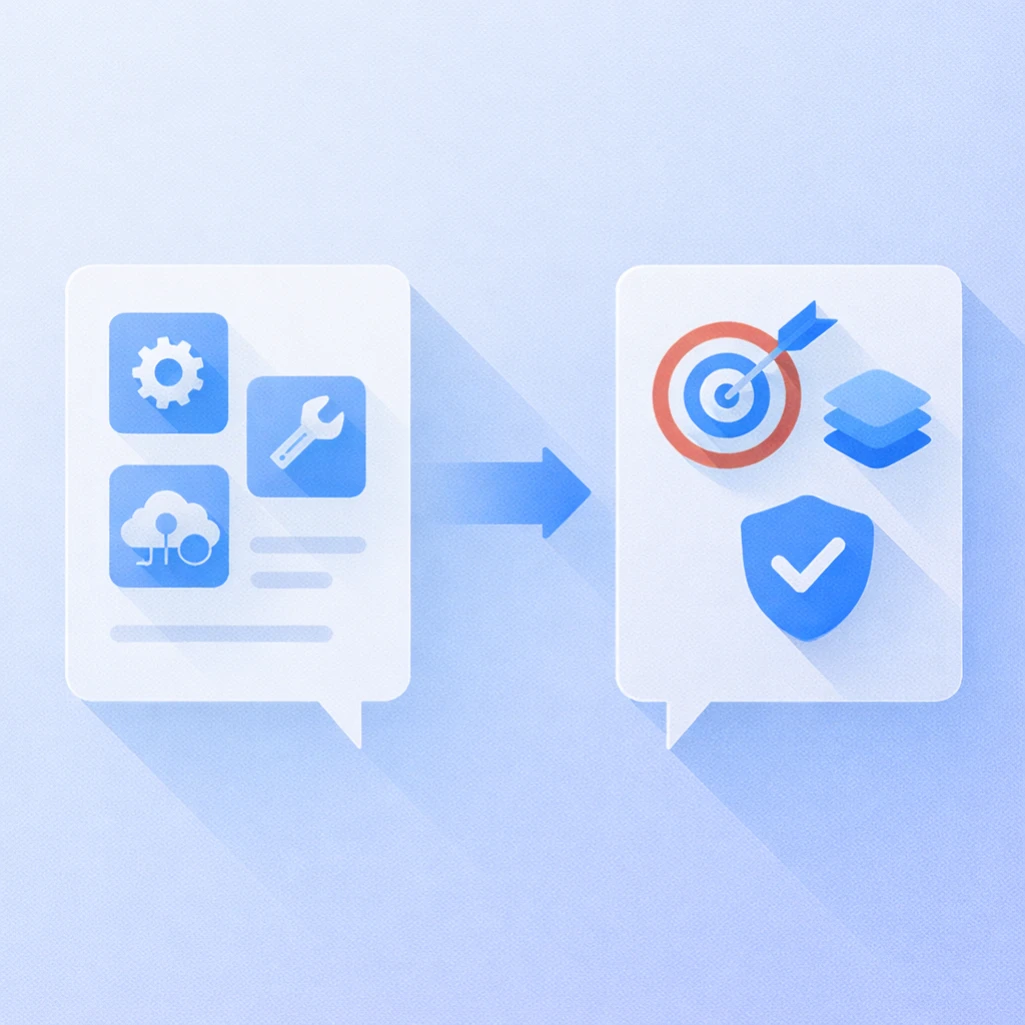
Features are what the product does. Value is what the customer gets.
People don’t buy “automated reporting.” They buy “stop wasting Fridays making reports.”
Here’s the translation playbook:
- Feature: “Automated data entry”
Value: “Save 5+ hours a week, your team spends time selling, not typing.” - Feature: “Role-based permissions”
Value: “Keep sensitive data locked down without slowing down the team.” - Feature: “AI summaries”
Value: “Get the key decisions in 30 seconds instead of rereading 20 messages.”
If your homepage headline is a feature list, you’re making the visitor do work. They will not do that work. They’ll bounce.
Clarity beats cleverness, every time
If your messaging needs a second read, it’s already losing.
Your goal is not to sound impressive. Your goal is to be understood by the right buyer instantly.
A good test:
If a smart 17-year-old can’t explain your product to a friend after reading your hero section, it’s too vague.
Fix the ambiguity with this 5-second checklist
Your first screen should answer:
- What is this? (category or use case)
- Who is it for? (specific person, team, or role)
- What problem does it solve? (real pain, not generic “efficiency”)
- What result do I get? (clear outcome, ideally measurable)
- What do I do next? (one obvious CTA)
If you miss even one, you create friction. Friction kills signups.
Positioning changes based on market maturity
A lot of founders copy big brands and forget why it works for them.
Slack can say “Where work happens” because everyone already knows what Slack is. You can’t.
If you’re in an immature market
People don’t fully understand the problem yet. Your site must educate.
- Call out the pain.
- Show the cost of doing nothing.
- Explain the new way clearly.
If you’re in an emerging market
People know the problem and are comparing options.
- Show how you’re different from alternatives.
- Make the “why you” obvious.
- Use proof early.
If you’re in a mature market
You’re fighting established players.
- Show your edge fast.
- Focus on what you do better, not what you do at all.
- Make switching feel safe.
Most SaaS sites screw this up by trying to sound like a category leader before they’ve earned it.
Write for the “champion,” not everyone
In B2B SaaS, the “champion” is the person most likely to start the buying process. Usually a manager, team lead, or operator.
If your homepage is written for “the entire company,” it will resonate with nobody.
Get specific:
- “For RevOps teams cleaning messy CRM data”
- “For recruiting teams scheduling 20+ interviews a week”
- “For support leads trying to cut first response time”
Specific is not limiting. Specific is persuasive.
Generic is invisible.
Turn features into value propositions with a simple formula
Stop guessing. Use a repeatable structure.
Step 1: Start with the job-to-be-done
What is the user trying to achieve?
Not “use software,” but:
- close deals faster
- ship releases with fewer incidents
- onboard customers without churn
- reduce back-and-forth and manual work
Step 2: Tie it to a measurable outcome
Numbers aren’t “nice to have.” They make claims believable.
Examples:
- “Cut onboarding time from 14 days to 7”
- “Reduce page load time by 40%”
- “Decrease churn by 10%”
- “Save 6 hours per rep per week”
Even if you don’t have perfect data yet, you can still be concrete:
- “In minutes, not hours”
- “Without spreadsheets”
- “Without switching tools”
Step 3: Add the differentiator
If your competitor can say it, delete it.
“Easy,” “modern,” “simple,” “powerful,” “AI-powered,” these mean nothing on their own.
Differentiators sound like:
- “Built for X workflow”
- “Works with Y stack out of the box”
- “Gives you Z insight competitors don’t”
- “Designed for teams with A constraint”
That is what makes a value prop defensible.
Use visuals to reduce cognitive load
SaaS messaging isn’t just words. It’s how fast someone can understand the product.
Do this:
- Show the UI early, not 7 scrolls down.
- Use short annotated screenshots, not vague product glamour shots.
- Add a 60 to 90 second demo video or interactive tour for complex products.
- Pair every “what” with a “so what.”
If your visitor has to imagine how it works, you’re losing them.
Don’t “SEO” your homepage to death
Yes, keywords matter. No, your homepage should not read like a robot wrote it.
A smart approach:
- Keep the homepage human and clear.
- Use supporting pages for keyword depth (use-case pages, feature pages, industry pages).
- Use blog posts to capture long-tail searches and educate buyers.
Google rewards clarity because clarity improves user behaviour. Better engagement, lower bounce, higher intent signals.
Build feedback loops so your messaging doesn’t rot
Messaging is not a one-time “brand exercise.” It’s a living asset.
1) Customer feedback
Ask:
- “What were you using before us?”
- “What pushed you to switch?”
- “What result mattered most?”
- “What almost stopped you from buying?”
Those answers are your best copy.
2) Sales feedback
Track:
- common objections
- confusion points
- phrases prospects repeat
If prospects keep asking “So what exactly do you do?”, your homepage failed.
3) Product usage data
Look for:
- which features correlate with retention
- which workflows drive activation
- where users drop off
Your best value prop is usually tied to the moment users feel value fastest.
4) Market feedback
Competitors change. Categories evolve. AI buzzwords get stale fast.
Keep your message grounded in outcomes, not hype.
Quick teardown: 3 common SaaS messaging fails (and the fix)
Fail 1: “All-in-one”
Problem: It’s vague. All-in-one what?
Fix: Name what’s included and why it matters.
Bad: “All-in-one customer data and analytics”
Better: “CRM + product analytics + segmentation, so marketing can act without waiting on data teams.”
Fail 2: “AI for more human experiences”
Problem: Sounds nice, says nothing.
Fix: Explain what the AI does, for who, and the payoff.
Better: “Automate interview scheduling and reminders, cut coordinator time by 80%.”
Fail 3: Generic outcomes everyone claims
Problem: “Increase revenue” is not messaging, it’s a wish.
Fix: Show the mechanism.
Better: “Recover abandoned carts with timed offers and personalised follow-ups.”
How NexaFlow approaches SaaS messaging (so it actually converts)
Most agencies jump straight into design. That’s backwards. If the message is unclear, a prettier layout just makes the confusion look expensive.
Our approach is simple:
- Get the positioning right first
What you do, who it’s for, why it’s different. - Turn features into buyer language
Less “platform,” more “here’s what changes for you.” - Build pages around intent
Homepage for clarity, landing pages for campaigns, feature and use-case pages for depth. - Design supports the message
Visual hierarchy, proof placement, clean CTAs, and speed. - Measure, then iterate
Analytics, heatmaps, A/B tests, then continuous improvements.
If you want, we can take your current homepage and rewrite the hero, subhead, and above-the-fold sections so a stranger can understand it instantly, then back it up with the right proof and page structure.
Conclusion
Clear SaaS messaging is not “better copy.” It’s the difference between a site that educates and converts, and a site that gets polite compliments and zero pipeline.
If your messaging is vague, people assume your product is vague. They move on.
Be specific. Be concrete. Say what you do in plain language. Prove it. Then make the next step obvious.